The case for a retained executive assistant
Hourly help solves today's task and forgets it by morning. A retained private office remembers and that memory is the whole point.

By The Executive Private Office · Diary, Inbox & Lifestyle Support
Most leaders try the hourly route first. A virtual assistant by the block, a freelancer for the overflow, a platform that promises help "on demand." It works for a fortnight. Then the cracks appear: you are re-explaining your preferences for the third time, chasing a handover that never quite happened, and quietly doing the admin yourself because briefing someone costs more time than the task.
The problem is not the person. It is the structure. Pay-as-you-go support is built around tasks, and tasks have no memory. A retained executive assistant is built around a relationship and a relationship compounds.
What "retained" actually means
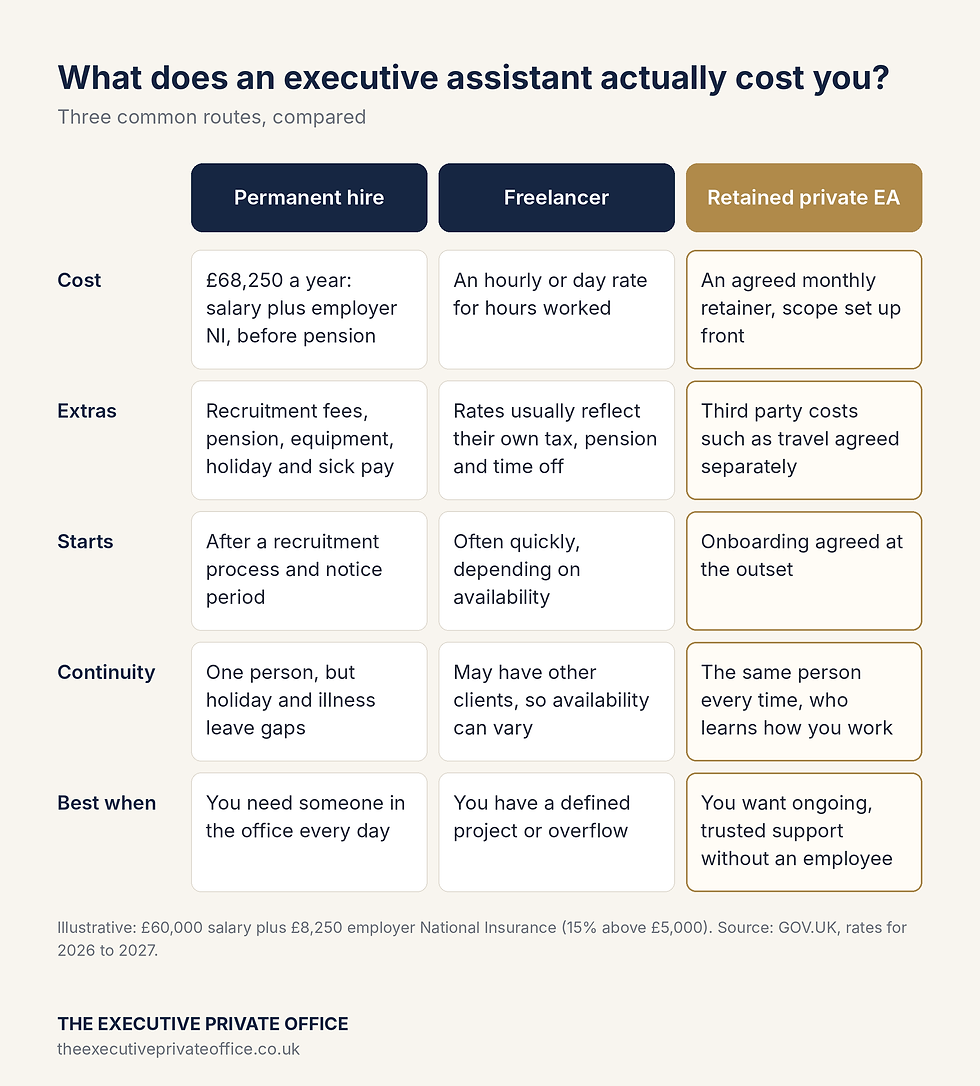
A retainer is a standing monthly engagement rather than a stopwatch. You are not buying hours; you are buying continuity, responsiveness, and a deepening understanding of how you work. The same trusted person holds your diary, your inbox, your travel and the personal arrangements around them — week after week, so context never resets.
Continuity — one point of contact who learns your rhythm and holds it.
Judgement — someone who makes the right call when you are not in the room.
Joined-up scope — diary, inbox and travel handled together, so nothing falls between briefs.
A short client list — attention that is never divided across dozens of accounts.
The first month of any retainer is an investment. Every month after that is a return.
Why hourly help keeps failing
Hourly models optimise for the wrong thing. They reward volume of tasks completed, not the quality of decisions made on your behalf. They rotate staff, so your preferences live in a document instead of a person's instinct. And they put the burden of coordination back on you — the very thing you were trying to delegate.
An executive support retainer inverts that. Because the relationship is ongoing, the office can act anticipatorily: booking the buffer before the back-to-back, flagging the clash before it lands, drafting the reply before you have asked. The work moves quietly into the background, and you stay forward-facing.
Is a retained private office right for you?
It tends to suit founders scaling quickly, CEOs whose calendars have become a queue of other people's urgency, and directors for whom privacy and protocol are non-negotiable. If your operational load is outpacing your day — and the cost of that is the strategic thinking only you can do — a retained private office is built precisely for the gap.
If that sounds like the season you are in, you are welcome to request an introduction.
Availability is intentionally limited.


Comments