Remote Executive Assistant vs In-House EA: Which Is Right for a CEO?

Remote Executive Assistant vs In-House EA: Which Is Right for a CEO?
It is an increasingly relevant question for founders, CEOs and directors who know they need support but are unsure whether that means making a permanent hire.
Traditionally, the answer was relatively straightforward.
A busy CEO hired an Executive Assistant who worked alongside them in the office.
Today, businesses operate differently. Leadership teams are more distributed. CEOs travel frequently. Hybrid working is established. Founders may operate several businesses or investments simultaneously, and much of the work surrounding a senior leader can be managed effectively without someone sitting outside their office.
That creates another option: retained remote executive support. But the decision shouldn't simply come down to cost.
The better question is:
Which model gives the CEO the right level of support, continuity and trust for the way they actually work?
What Is an In-House Executive Assistant?
An in-house Executive Assistant is employed directly by the business, usually on a full-time basis. Depending on the organisation and the seniority of the role, they may manage the CEO's diary, inbox, travel, meetings, expenses, stakeholder relationships, projects and wider administrative requirements.
For some CEOs, this is exactly the right model. An experienced in-house EA can become an extremely important member of the leadership infrastructure, particularly where the principal has a substantial volume of daily office-based activity. But employing an EA also means creating a permanent role. Salary is only one part of that commitment.
There is recruitment, employer National Insurance, pension contributions, holiday, benefits, equipment, onboarding, management and the wider responsibility associated with employing another member of staff.
For a CEO who genuinely needs full-time support, that investment can make complete sense.
For someone who needs senior support but not necessarily another full-time employee, it may be more infrastructure than required.
What Is a Remote Executive Assistant?
A Remote Executive Assistant provides many of the same core functions without being permanently based in the client's office.
That can include:
Strategic diary and calendar management
Executive inbox management
Meeting coordination
Travel and itinerary planning
Research
Project coordination
Stakeholder liaison
Follow-ups and action tracking
Document and administrative oversight
Personal diary management
Reservations and appointments
Property and household liaison
Personal travel and lifestyle logistics
The physical location changes. The need for judgement, discretion and reliability does not.
A good Remote Executive Assistant should not feel like an external task service.
They should become a trusted part of the operating structure around the CEO.
Remote Does Not Have to Mean Impersonal
One of the biggest misconceptions about remote executive support is that it must be transactional.
Send a task.
Receive the result.
Send another task.
That is closer to a conventional virtual assistant model.
Senior executive support should work differently. When the relationship is retained and consistent, the EA develops context.
They learn how the CEO works.
They understand preferences.
They recognise important relationships.
They know which meetings can move and which cannot.
They understand how much preparation time is required before a board meeting.
They know preferred airlines, hotels and travel arrangements.
They begin to recognise what should be escalated immediately and what can be dealt with quietly in the background. Over time, less explanation should be required.
That accumulated understanding is one of the most valuable parts of the relationship.
When Does an In-House EA Make Sense?
There are situations where an employed Executive Assistant is likely to be the stronger option. A CEO may need someone physically present throughout the working week.
There may be substantial office-based responsibilities.
The role may involve frequent physical document handling, hosting visitors or responsibilities that genuinely require an on-site presence.
The CEO may also have enough work to justify a dedicated full-time role.
In those circumstances, recruiting an excellent senior EA can be a very worthwhile investment.
The purpose of remote support is not to argue that employed EAs are unnecessary.
It is to recognise that not every senior leader requires the same model.
When Does a Remote Executive Assistant Make Sense?
Remote executive support can be particularly attractive when a CEO or founder:
Needs senior-level support but does not require a full-time employee.
Works remotely or across several locations.
Travels frequently.
Runs more than one business.
Has a relatively lean leadership team.
Wants support across both business and personal administration.
Needs flexibility as their requirements change.
Has recently lost an EA and needs continuity.
Has reached the point where administration is consuming too much leadership time.
Wants to avoid a lengthy recruitment process.
Values discretion and a close one-to-one working relationship.
This is often the space occupied by founders and CEOs whose businesses have become sophisticated enough to require executive support but whose circumstances do not neatly fit a traditional full-time EA position.
Remote Executive Assistant vs In-House EA: Which Is Right for a CEO?
The answer comes down to more than where the assistant works.
Consider the volume of support you genuinely need
If there is enough meaningful work for a senior EA every day, a permanent hire may be appropriate.
If your requirements are significant but do not justify a full-time position, retained remote support may provide a better fit.
Consider where you actually work
If you spend five days a week in one office and need constant physical support, proximity may matter.
If you divide your time between home, offices, client locations and travel, having an assistant sitting at one physical location may be considerably less important.
Consider what you want to delegate
If your primary requirements are diary, inbox, travel, coordination, research, projects and personal logistics, much of this can be handled remotely.
If substantial elements of the role require somebody physically present, an in-house EA becomes more attractive.
Consider how much employment infrastructure you want
A permanent hire creates a permanent employment relationship.
That can be exactly right.
But CEOs should make that decision because they need a full-time employee, rather than because they assume it is the only way to access high-quality executive support.
Consider the level of trust required
Whether remote or employed, this is perhaps the most important consideration.
An Executive Assistant may have access to your diary, inbox, travel arrangements, personal information, confidential business discussions and sensitive relationships.
The cheapest option is therefore rarely the most sensible criterion.
You are selecting someone to operate close to the centre of your professional and potentially personal life.
Trust, discretion and judgement matter.
What About Cost?
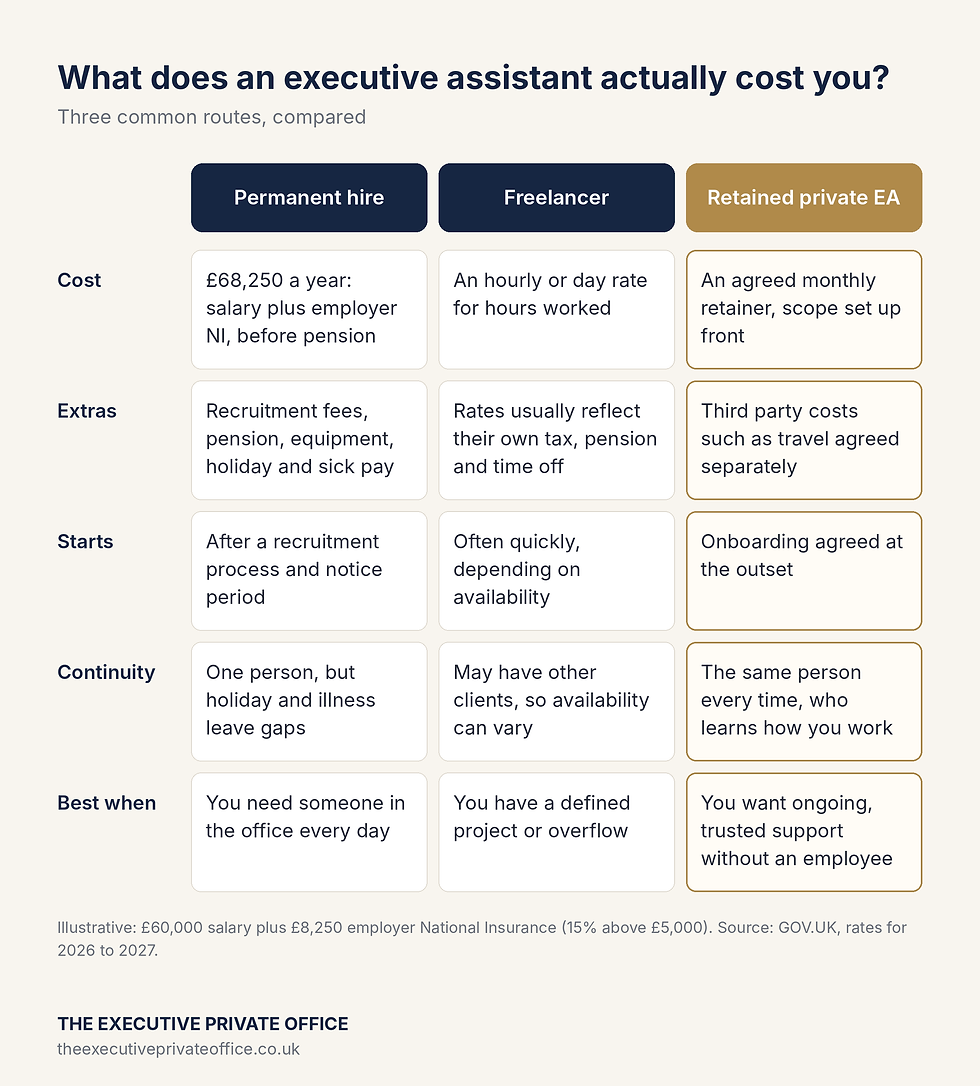
Cost naturally forms part of the decision. But comparing an employed EA's salary directly with a remote support retainer doesn't give the complete picture.
A permanent employee can involve salary, employer contributions, pension, benefits, recruitment, equipment, holiday and other employment costs.
A retained Remote Executive Assistant operates under a different commercial model.
But there is an even more important calculation.
What is currently happening to the CEO's time?
If a CEO is personally spending ten hours each week on diary administration, email, travel, coordination and follow-ups, the business is already paying for those tasks.
It is simply paying for them with CEO time.
And that may be the most expensive resource available.
Don't Choose Based on Hours Alone
There is a temptation when considering remote support to ask:
"How many hours do I get?"
It is understandable, but it isn't necessarily the best measure of value.
A senior Executive Assistant who understands the principal, anticipates requirements and resolves issues without unnecessary involvement can create far more value than someone completing a predetermined number of isolated tasks.
The goal should be to reduce the amount of operational friction reaching the CEO.
That means measuring the relationship by outcomes:
Is the diary under control?
Is the inbox manageable?
Is travel handled?
Are people being followed up?
Are actions moving?
Is less administration reaching the CEO?
Is the CEO getting meaningful time back?
Those questions tell you considerably more than an hours counter.
What If You Need Business and Personal Support?
This is another area where the right model can make a significant difference.
For many CEOs and founders, professional and personal demands constantly overlap.
A business trip affects family arrangements.
A personal appointment affects the diary.
Property matters need dealing with during working hours.
Reservations need coordinating around meetings.
Personal travel needs to work alongside business commitments.
Using separate people for every part of an executive's life can create even more coordination.
A private office style relationship allows appropriate professional and personal responsibilities to be managed together, with discretion and clear boundaries.
For the right client, this can be considerably more useful than conventional business-only administrative support.
The Right EA Should Remove Management, Not Create More of It
Whether you choose an employed or remote Executive Assistant, one principle should remain the same.
Your assistant should reduce the amount you have to manage.
If you are continually creating task lists, checking progress, explaining the same preferences and reminding someone what needs to happen, you have simply acquired another management responsibility. Strong executive support develops ownership.
The relationship moves from:
"Can you do this for me?"
to:
"Please take care of it."
And eventually, many things are taken care of before the CEO needs to ask.
The Decision Is Really About How You Want to Work
The choice between a Remote Executive Assistant and an in-house EA isn't about deciding which model is universally better. Neither is.
It is about building the right support structure around the CEO.
For some, that will mean an excellent full-time Executive Assistant working within the business. For others, it will mean a trusted remote partner who provides continuity, discretion and senior-level support without the commitment of another permanent position.
What matters is the result.
The CEO should spend less time managing the mechanics surrounding their role and more time on the work that genuinely requires their leadership.
At The Executive Private Office, we provide retained remote Executive Assistant and private office support for UK CEOs, founders and directors.
We deliberately work with a limited number of clients so that each relationship can develop the context, continuity and trust that high-level executive support requires.
Our role isn't simply to complete tasks remotely.
It is to take ownership of the operational demands surrounding the principal, across diary, inbox, travel, coordination and, where appropriate, personal and lifestyle requirements.
Because the best support shouldn't simply give a CEO assistance. It should give them their time back.
If you're considering executive support but don't need another full-time employee, The Executive Private Office offers a discreet alternative.


Comments