The Real Cost of a CEO Managing Their Own Diary and Inbox

The Real Cost of a CEO Managing Their Own Diary and Inbox isn't measured by how long it takes to move a meeting or answer an email.
It's measured by what that time could have been used for instead.
For many CEOs, founders and directors, managing their own diary and inbox feels perfectly normal. It may even feel efficient.
Why employ or engage someone else when you can deal with an email in two minutes, move a meeting yourself or book a train between calls?
The problem is that those two-minute tasks rarely happen once.
They happen dozens of times throughout the day.
And every interruption comes with another cost: your attention.
The CEO Who Is "Just Quickly" Doing Everything
There is a particular phrase that should concern any busy executive:
"I'll just do it quickly."
I'll just reply to this email.
I'll just find another time for the meeting.
I'll just book the hotel.
I'll just chase that person.
I'll just check the diary.
Individually, none of these things seems significant enough to delegate.
Collectively, they can consume an extraordinary amount of executive capacity.
Imagine spending just 90 minutes each working day dealing with diary administration, emails, coordination and follow-ups.
That's 7.5 hours every week.
Approximately 30 hours every month.
And potentially hundreds of hours over the course of a year.
The question isn't whether a CEO is capable of doing those things.
Of course they are.
The question is whether that's where the business needs their time.
Your Diary Is a Commercial Asset
An executive diary shouldn't simply tell you where you're going next.
It should reflect the priorities of the business.
That means protecting time for strategy, clients, leadership, thinking, decision-making and the activities where the CEO creates disproportionate value.
But when you're personally managing your calendar, it becomes very easy to manage meetings rather than manage priorities.
Requests arrive.
Meetings get accepted.
People ask for "just 20 minutes".
Calls are squeezed into gaps.
Preparation time disappears.
Travel isn't properly accounted for.
And suddenly the diary is full, but the work that matters most is being fitted around it.
Executive diary management is therefore not simply scheduling.
Done properly, it is the deliberate protection and allocation of executive capacity.
The Real Cost of a CEO Managing Their Own Diary and Inbox Is Interruption
The obvious cost is time.
The less obvious cost is fragmentation. Every time you stop what you're doing to check an email or deal with a calendar request, your attention moves away from the task in front of you.
You might be reviewing a proposal.
Thinking through a hiring decision.
Preparing for an investor meeting.
Working on strategy.
Then an email arrives.
It only takes three minutes to answer.
But the true interruption is not necessarily three minutes.
You've broken your concentration and introduced another subject into your thinking.
Repeat that throughout the day and you can be extremely busy without having had much uninterrupted time to think.
For a senior executive, that matters.
Your value doesn't come from processing the greatest number of tasks.
It comes from making good decisions about the relatively small number of things that have significant consequences.
Your Inbox Shouldn't Be Your To-Do List
An unmanaged executive inbox allows other people's priorities to determine your attention.
Every incoming message effectively says:
"Look at this."
"Decide this."
"Respond to me."
"Deal with this now."
The more senior you become, the more people have a reason to contact you.
Clients.
Employees.
Suppliers.
Advisers.
Investors.
Recruiters.
Partners.
Professional contacts.
And an endless stream of people who would simply like some of your time.
Without a system around that communication, the CEO becomes the filter.
That is rarely scalable.
What Executive Inbox Management Actually Looks Like
Effective executive inbox management isn't about handing someone your password and hoping for the best.
It requires trust, discretion, judgement and agreed parameters.
An experienced Executive Assistant can help filter incoming communication, identify priorities, organise messages, draft or send appropriate responses, track outstanding actions and ensure important correspondence is brought to your attention.
The objective isn't necessarily to prevent you from seeing your inbox.
It's to stop the inbox from controlling you.
Instead of processing every message personally, you spend your time on the communications that genuinely require your judgement, relationship or authority.
Everything else has somewhere to go.
What Executive Diary Management Actually Looks Like
The same principle applies to your calendar.
Strong diary management can include:
Prioritising meetings according to genuine importance.
Protecting uninterrupted time for strategic work.
Coordinating multiple stakeholders without involving the CEO in the logistics.
Accounting properly for preparation and travel.
Challenging meetings that don't need the executive.
Managing changes and cancellations.
Creating appropriate buffers between demanding commitments.
Making sure the right information is available before important meetings.
Coordinating business and personal commitments where appropriate.
The diary becomes intentional rather than reactive.
And the CEO no longer acts as their own scheduling department.
Calculate the Value of Your Own Time
One useful exercise is to put a commercial value on an hour of CEO time. Not necessarily based on salary. Instead, consider what an hour of your attention could potentially contribute when directed towards the highest-value areas of the business.
Winning or retaining a significant client.
Building an important relationship.
Recruiting a senior employee.
Reviewing an acquisition.
Solving a strategic problem.
Developing a new revenue opportunity.
Making a better decision.
Then compare that with an hour spent rearranging meetings and processing routine correspondence.
This is where the economics of executive support become interesting.
Delegation is sometimes viewed as an additional expense.
But if support releases valuable executive capacity, doing everything yourself can be the considerably more expensive option.
The Hidden Cost Is What Doesn't Happen
There is another cost that is almost impossible to see.
Opportunity cost.
The strategy session you keep postponing.
The client you haven't called.
The proposal you haven't reviewed properly.
The thinking time that disappears because the diary is full.
The important relationship that hasn't received enough attention.
The business development activity you keep meaning to start.
The weekend spent clearing email instead of properly switching off.
These don't appear on a profit and loss statement as "cost of CEO administration".
But they are costs nonetheless.
And in a growing business, they can become substantial.
When Should a CEO Delegate Their Diary and Inbox?
There isn't a specific company size or turnover at which executive support suddenly becomes necessary.
A better measure is executive friction.
Consider whether:
You regularly process email outside normal working hours.
Your diary is constantly changing.
People frequently contact you directly to arrange meetings.
You spend your own time chasing availability.
Important emails occasionally disappear amongst everything else.
Your calendar leaves little uninterrupted thinking time.
Administrative work spills into evenings or weekends.
You are frequently switching between strategic and administrative tasks.
You are becoming the point through which too many things have to pass.
You know you should delegate more, but haven't built the support around you to do it.
If several of those are familiar, your workload may not be the only issue.
Your operating structure may need to change.
Remote Executive Support Can Be the Middle Ground
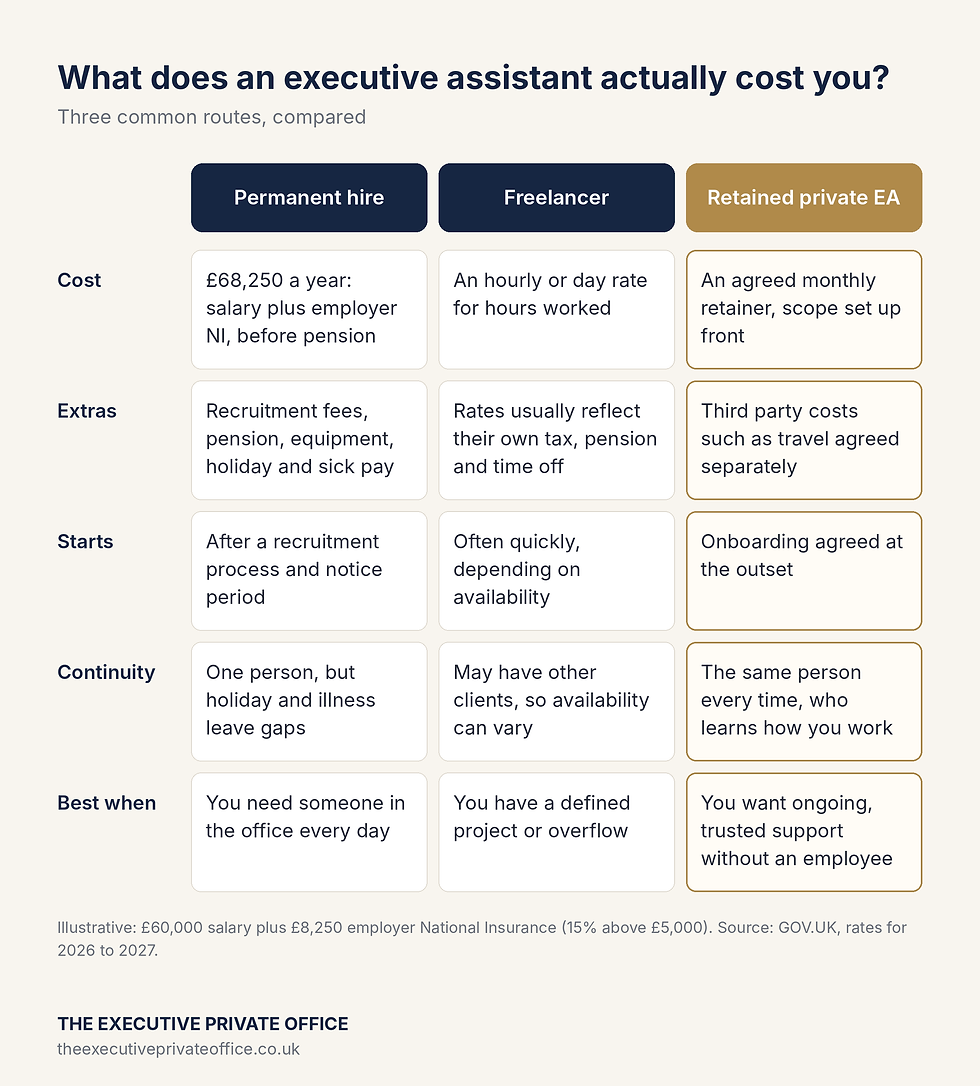
Not every CEO needs a full-time employed Executive Assistant. And not every business wants the additional salary, National Insurance, benefits, recruitment and management commitment associated with another permanent senior employee.
For some founders and directors, retained remote executive support provides a useful middle ground.
The executive gains consistent, senior-level support without necessarily creating a full-time internal role. But consistency matters.
The objective shouldn't be to send miscellaneous tasks to whichever assistant happens to be available.
Executive support becomes considerably more valuable when one trusted person builds context around the principal.
They learn your diary.
Your preferences.
Your relationships.
Your travel habits.
Your priorities.
Your working style.
And eventually, fewer things need to be explained.
Delegation Should Reduce Your Management Load
There is little value in delegating administration if you then have to manage the delegation itself.
A CEO shouldn't need to spend the day creating task lists for their Executive Assistant.
High-quality executive support should progressively remove that requirement.
Instead of:
"Please book this."
"Please chase that."
"Please move this meeting."
The relationship develops towards:
"Please handle it."
That distinction is important.
You're no longer simply buying assistance.
You're creating trusted operational ownership around yourself.
So, What Is the Real Cost of a CEO Managing Their Own Diary and Inbox?
It is more than the minutes spent replying to messages or moving appointments.
It is interrupted concentration.
Lost thinking time.
Reduced leadership capacity.
Delayed decisions.
Administrative work creeping into evenings.
Opportunities that receive less attention than they should.
And potentially hundreds of hours each year spent on activities that never required the CEO
in the first place.
At The Executive Private Office, we provide retained remote Executive Assistant and private office support for UK CEOs, founders and directors who want to protect their time without necessarily employing a full-time EA.
Diary and inbox management form part of a much broader relationship built around discretion, continuity, judgement and understanding how the principal operates.
Because the objective isn't simply to organise your diary.
It's to make sure your diary reflects the value of your time.
If you are spending too much of your working week managing the mechanics around your role rather than the responsibilities only you can fulfil, it may be time to change where that work sits.
We buy back your time, so you can focus on leading.


Comments