What Does an Executive Assistant Actually Take Off a CEO's Plate?

For many CEOs and founders, the working day has quietly become filled with tasks that do not actually require their expertise.
Diary changes. Emails. Travel arrangements. Meeting coordination. Chasing responses. Reservations. Research. Follow-ups. Keeping track of actions. Making sure the right people are in the right place at the right time.
Individually, these tasks can appear relatively insignificant.
Collectively, they can consume hours of valuable executive time every week.
The question is not simply whether you can manage these things yourself. Most successful executives can.
The better question is: should you?
When your time carries significant commercial value, spending it on coordination and administration is rarely the most effective use of it.
This is where high-level executive support becomes considerably more valuable than simply having someone available to complete administrative tasks.
An Executive Assistant Should Give You Capacity, Not Just Complete Tasks
The traditional perception of an Executive Assistant can be surprisingly narrow.
Diary management. Booking meetings. Arranging travel. Answering emails.
Those things matter, but excellent executive support goes considerably further.
A senior Executive Assistant becomes part of the operating infrastructure around an executive. They understand priorities, anticipate requirements, protect time, maintain momentum and ensure that hundreds of small operational demands do not continually find their way back to the CEO.
The objective is not simply to make your administration more efficient.
It is to give you back executive capacity.
That means more uninterrupted time for leadership, clients, strategy, investment, growth and the decisions that genuinely require you.
1. Strategic Diary and Calendar Management
A CEO's diary is not simply a collection of appointments.
It is an allocation of one of the company's most valuable resources: executive time.
Effective diary management therefore involves considerably more than accepting meeting invitations.
It can include coordinating complex schedules, protecting time for strategic work, managing competing priorities, reducing unnecessary meetings, arranging preparation time and ensuring the diary reflects what actually matters to the business.
There is also the constant stream of changes.
A meeting moves. Someone needs 30 minutes urgently. Travel plans change. A client needs to be accommodated. A board meeting overruns.
Without support, every one of those changes can become another interruption for the executive.
A good Executive Assistant absorbs that disruption before it reaches you.
2. Executive Inbox Management
An overflowing inbox creates more than an administrative problem.
It creates cognitive load.
Every unread message represents another decision waiting to be made: respond, delegate, file, follow up, schedule, decline or investigate.
Senior executive inbox management can involve filtering incoming correspondence, identifying genuine priorities, drafting responses, organising follow-ups and ensuring important communications do not disappear beneath everything else.
Instead of repeatedly checking hundreds of messages, the executive can concentrate on the communications that genuinely require their judgement or personal involvement.
The inbox stops dictating the working day.
3. Meetings and Stakeholder Coordination
The meeting itself may last an hour.
The administration surrounding it can take considerably longer.
Finding availability, communicating with attendees, rearranging diaries, booking locations, circulating information, preparing agendas, recording actions and following up afterwards all require time.
For a CEO managing multiple stakeholders, advisers, investors, clients and leadership teams, this coordination quickly accumulates.
Executive support creates a single point of ownership.
The CEO attends the meeting.
Someone else makes sure everything around it happens.
4. Executive Travel and Itinerary Management
Frequent business travel creates an extraordinary number of small decisions.
Flights. Hotels. Transfers. Timings. Meeting locations. Reservations. Changes. Visas. Documents. Preferences. Contingencies.
A well-managed executive trip should feel almost effortless to the person travelling.
Flights work around the diary. Transfers are coordinated. Accommodation is appropriate. Meeting locations make sense. Information is available when needed. Changes are dealt with without creating unnecessary disruption.
For executives travelling regularly around the UK or internationally, delegating travel management can remove a substantial operational burden.
More importantly, it allows the executive to travel without simultaneously having to administer the trip.
5. Follow-Ups and Action Tracking
Many businesses do not suffer from a shortage of ideas.
They suffer from a shortage of follow-through.
A conversation happens. An action is agreed. Someone needs to send something. Another person needs to be chased. A decision needs to be revisited next week.
Without ownership, these small commitments can disappear into busy schedules.
Executive support can provide that continuity.
Actions are captured. Deadlines are tracked. People are followed up. Information is gathered. Outstanding matters are brought back at the appropriate time.
The executive does not need to keep every open loop in their head.
6. Research and Project Support
Not every project requires another permanent employee.
Sometimes the executive simply needs a trusted person who can take ownership of the coordination.
That might mean researching suppliers, gathering information, comparing options, preparing documents, coordinating stakeholders, tracking progress or ensuring a project continues moving while the CEO focuses elsewhere.
This is particularly valuable for founders and business owners who have reached the point where they are involved in too many operational details.
The right support creates distance between the executive and the mechanics of getting things done, without losing visibility or control.
7. Personal and Lifestyle Administration
For many CEOs, founders and business owners, the distinction between professional and personal administration is increasingly artificial.
A demanding business diary does not exist separately from family commitments, appointments, travel, properties, events and personal responsibilities.
Everything competes for the same finite amount of time.
This is why private office style executive support can extend beyond the traditional boundaries of a corporate EA.
Personal diary coordination, reservations, appointments, events, household or property liaison, travel and other lifestyle requirements can all be managed alongside business responsibilities.
For a busy executive, having one trusted point of coordination across both worlds can be enormously valuable.
It reduces fragmentation and removes the need to manage multiple people simply to manage your own life.
What Is the Real Value of Executive Support?
The easiest way to assess the value of executive support is not to count administrative tasks.
Look instead at the executive time being recovered.
Imagine a CEO spends eight hours each week managing their diary, processing email, organising travel, coordinating meetings, chasing information and handling personal logistics.
That is effectively an entire working day.
Over a year, it becomes hundreds of hours of executive capacity.
The commercial question is therefore not:
"How much does an Executive Assistant cost?"
It is:
"What is the value of the time the Executive Assistant gives back?"
If an executive can use those recovered hours to win business, strengthen key relationships, make better decisions, lead their team or simply create the thinking space required to run the company properly, the economics of delegation change considerably.
Remote Executive Assistant or Full-Time Employee?
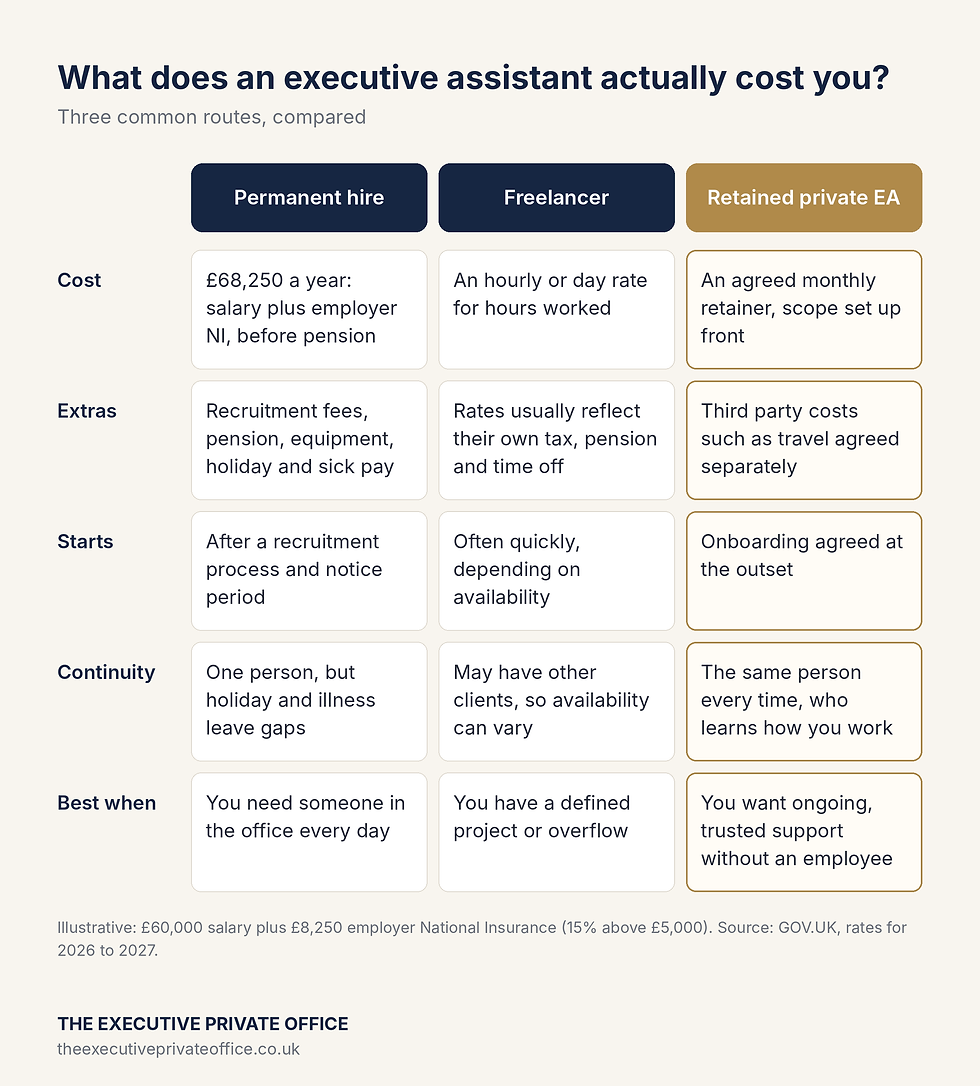
Not every CEO needs, or wants, a full-time Executive Assistant sitting outside their office.
For some businesses, an employed EA is absolutely the right solution.
For others, particularly founders, entrepreneurs and directors of growing businesses, a retained remote Executive Assistant can provide senior-level support without creating another full-time position.
The important distinction is between a generic task-based virtual assistant service and genuinely high-level executive support.
A CEO should not need to continually explain what needs doing, manage the person providing support or distribute isolated tasks throughout the day.
The relationship should become more valuable as context builds.
Your Executive Assistant should learn how you work, understand your preferences, recognise your priorities and increasingly anticipate what will be required.
That is where retained executive support begins to resemble a private office rather than outsourced administration.
How Do You Know When You Need an Executive Assistant?
You may not need support simply because you are busy.
The stronger indication is that your time has become the bottleneck.
You may benefit from executive support if:
Your inbox repeatedly interrupts strategic work.
You are personally coordinating meetings and diary changes.
Travel planning regularly consumes your time.
People are waiting for you to follow things up.
Administrative tasks spill into evenings or weekends.
Your business has grown, but your personal operating system has not.
You are managing several companies, investments or locations.
Business and personal commitments have become difficult to coordinate.
You spend significant time on work that someone trusted could handle for you.
You need senior support but do not currently require a full-time employed EA.
If several of these sound familiar, the issue may not be workload.
It may be where your workload is sitting.
Buying Back Your Time
Successful executives often become accustomed to carrying an enormous amount themselves.
But being capable of doing something does not make it the best use of your time.
The purpose of exceptional executive support is to quietly remove the operational demands that should never have reached your desk in the first place.
Your diary is managed.
Your inbox is controlled.
Your travel is organised.
People are followed up.
Actions move forward.
Personal logistics are handled.
And you regain the capacity to concentrate on the responsibilities that genuinely require you.
At The Executive Private Office, we provide retained remote Executive Assistant and private office support for UK CEOs, founders and directors who place a high value on their time.
Our approach is discreet, proactive and highly personal. We deliberately keep our client list limited so that support remains consistent, trusted and deeply embedded in the way each principal operates.
If too much of your working week is being consumed by coordination, administration and logistics, it may be time to reconsider what actually requires your attention.


Comments